
Lip filler is one of the most popular aesthetic treatments on social media right now. On camera, it often looks quick and simple. In reality, the lips are a highly detailed and anatomically nuanced area that requires precision and experience.
Because the lips contain important vascular structures and specific “danger zones,” treatment should always be performed by an experienced injector who understands lip anatomy, uses appropriate technique, and prioritizes safety. When done thoughtfully and skillfully, lip enhancement can look natural, balanced, and beautifully refined.
In this blog, we will answer common questions regarding lip filler such as Volbella (Allergan), RHA3 (Revance), and others. Our goal is to help you better understand how technique, anatomy, and tissue mechanics all play a role in injection safety.
@drarthurmiami Take a look at Miami’s take on the Swedish Lip—pioneered by Dr. Rebecka Gardell. This technique uses a firmer filler placed behind the muscle for that effortlessly full, sculpted pout. 👄💉 Have a question? Contact us to schedule your FREE consultation today 📲305.403.2922 📧Assistant@arthurmd.com Insta: @drarthurmiami Website: https://arthurmd.com/home/medical-spa-non-surgical-procedures/#fillers #miami #plasticsurgeon #DrDesrosiers #explorepage #fypシ゚viral #fyp #medical #med #filler #injections #swedishlips #lipinjections #fullerlips #upperlip #lips #juvederm #vollure ♬ Magic - Extended - Ben Macklin
What are the Anatomical Structures of the Lips?
Your lips aren’t just skin. They are made up of different layers that affect the appearance and movement of filler.1
These layers include (top to deep):
- Skin and vermillion border (where lip liner is usually placed).
- Subcutaneous tissue.
- Orbicularis oris: the primary lip muscle responsible for talking and smiling.
- Labial arteries: there are blood vessels and how shallow or deep they are below the lip’s surface varies among individuals, making careful injection planning essential.1
- Oral mucosa: the smooth surface inside of the mouth.

Source: Hong GW, Choi W, Yoon SE, Wan J, Yi KH. Anatomical-Based Diagnosis and Filler Injection Techniques: Lips and Philtrum. Life (Basel). 2025 Feb 18;15(2):315. doi: 10.3390/life15020315. PMID: 40003724; PMCID: PMC11856795.
Important nerves and arteries are present throughout the lips, which is why it is important for each patient’s unique anatomy to be evaluated to help determine proper injection technique.
“Danger Zones” and “Safe Zones” For Lip Filler Injections
Lip filler may look simple on social media, but the lips are one of the most anatomically detailed areas of the face.
When we talk about safety, what we really mean is understanding where the important blood vessels are located and how to avoid them.
This is why lip filler is not a “quick” procedure – it is a technical one.

Source: Hong GW, Choi W, Yoon SE, Wan J, Yi KH. Anatomical-Based Diagnosis and Filler Injection Techniques: Lips and Philtrum. Life (Basel). 2025 Feb 18;15(2):315. doi: 10.3390/life15020315. PMID: 40003724; PMCID: PMC11856795.
Lip Filler Safer Zones vs. Higher-Risk Areas
1) The Wet–Dry Border (“Red–Red Roll”)
This is the transition line where the outer dry pink lip meets the inner moist lip of the mouth. When treated very superficially and carefully, this area is commonly and safely enhanced. However, it becomes higher risk if injections are placed too deep or delivered with high pressure.
- Safer approach: Superficial, precise placement in the correct plane.
- Avoid: Deep bolus injections in this area.
2) The Central Upper Lip (Cupid’s Bow)
The center of the upper lip contains the superior labial artery. In some people, this vessel runs deeper. In others, it may be more superficial. This variability makes the central upper lip a higher-caution area.
- Safer approach: Conservative volume, slow injection, careful depth control.
- Avoid: Blind, high-pressure, deep bolus injections.
3) The Corners of the Mouth (Commissures)
Multiple vascular branches converge near the corners of the mouth. Depth and vessel position vary from person to person. This is an anatomically complex area that requires thoughtful technique.
- Safer approach: Small, controlled placement with strong awareness of depth.
- Avoid: Aggressive deep injection without clear anatomical understanding.
4) The True “No-Go” Plane: Deep Inside the Lip Muscle
This is the most important safety concept. The major lip arteries typically run within or just beneath the orbicularis oris muscle. Deep intramuscular injections significantly increase the risk of vascular injury or compression. For cosmetic lip shaping, there is rarely a reason to inject deeply into the muscle itself.
- Safer approach: Respecting superficial and appropriate submucosal planes.
- Avoid: Deep intramuscular bolus injections.
5) The Superficial Vermilion Border (The Lip Line)
The vermilion border is the outer edge of the pink lip – the area that defines the lip shape and where lip liner is typically applied. While few patients require injection along the vermillion border, this is generally a safer treatment zone – when treated superficially and conservatively. The major lip arteries usually run deeper than this layer. When filler is placed very superficially and precisely along the border, it is typically above the main vascular plane. However, safety depends entirely on depth and technique.
Safer approach:
- Very superficial placement
- Small, controlled amounts
- Slow, low-pressure injection
Avoid:
- Deep injection beneath the border
- Large bolus placement
- High-pressure injection
6) The Lateral Lip Body
Safer approach:
- Conservative volume
- Superficial or appropriate submucosal plane
- Small, controlled placement
Avoid:
- Deep intramuscular bolus injections
- Aggressive volumization
- Blind high-pressure technique
And Remember: Anatomy Varies from Person to Person
Not everyone’s blood vessels are located in exactly the same place. Some people naturally have vessels that run more superficially or slightly differently than expected. This is why lip filler should always be performed by an experienced medical injector.
It is also why we keep hyaluronidase (Hylenex) immediately available in the office. Hyaluronidase can safely dissolve hyaluronic acid filler if needed. Serious vascular complications are rare, but responsible aesthetic care means being prepared for every possibility.
Common Lip Filler Techniques
Here is what these techniques actually mean:

Russian Lips
Patients frequently ask about the Russian lip technique due to the dramatic, lifted result resembling a “Bratz doll.” The Russian lip technique involves inserting the needle at or near the vermilion border, which is the top edge of the pink lip, and advancing it into the body of the lip. Filler is then deposited as the needle is withdrawn, creating vertical columns of product. This process is repeated across the central portion of the upper and lower lips, typically between the peaks of the Cupid’s Bow and extending toward the base of the nose. This vertical stacking of filler is intended to increase lip height and sharpen Cupid’s Bow definition.
However, because filler is placed in structured vertical pillars starting from the lip border inward, it often:
- Pushes the lip forward (increasing anterior projection)
- Produces a sharp border between the lip and surrounding skin
- Increases the risk of stiffness or visible migration with repeated treatments
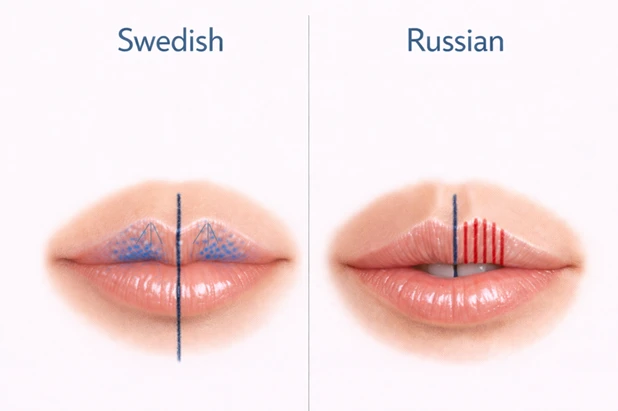
Swedish Lips
Patients often ask about the “Swedish lip” technique when they want a natural result without obvious projection.
What people tend to like about this approach is that there is minimal anterior projection. In other words, there is no dramatic “step-off” between the lip and the surrounding skin. The side profile remains smooth and continuous rather than shelf-like.
The overall effect is soft, balanced, and anatomically harmonious.
How the Swedish Lip Technique Is Performed
Step 1: Deep Structural Support
A cannula is used to place a firmer filler in a deeper structural plane behind the orbicularis oris muscle. This supports the lip from underneath rather than stacking filler near the surface.
The goal is subtle support, not forward push.
Because the major labial arteries run within or near the muscle, a cannula must be used.
Step 2: Superficial Micro-Droplet Refinement
Small microdroplets of filler like Vollure, Volbella, or RHA3 are then placed superficially into natural concavities of the lip. This smooths contour irregularities and enhances hydration without creating bulk.
The emphasis is on blending and refinement rather than border exaggeration.
Step 3: Limited Reverse Vertical Structuring
In this step, the needle enters near the wet–dry border of the upper lip and is advanced upward toward the peak of the Cupid’s Bow. As the needle is slowly withdrawn, a small amount of filler is deposited along the tract.
This process is repeated to create three controlled vertical columns that converge just beneath each peak of the Cupid’s Bow. Rather than stacking large amounts of product, the goal is subtle structural support.
When performed conservatively and in the appropriate plane, this technique enhances definition and reinforces the natural contour of the Cupid’s Bow without creating excessive anterior projection or a sharp step-off from the surrounding skin.
How to Prevent Lip Filler Migration Post-Injection
One of the most common concerns patients have about lip filler is something called “migration.” The word sounds dramatic, but what it really describes is fairly simple: filler that has gradually moved outside the area where it was originally placed.
In the lips, this most often shows up as product sitting above the natural lip border, creating a blurred outline or what many people casually refer to as a “filler mustache.” Migration is usually the result of placing too much volume too quickly or placing filler directly into the vermilion border itself.
The lips are delicate, highly mobile structures. They stretch and compress constantly as we speak, smile, and eat. When a large amount of filler is introduced in a single session, particularly into tissue that has never been expanded before, internal pressure increases. Over time, that pressure can encourage product to move beyond its intended boundary.
This is especially relevant for patients who naturally have smaller lips. Smaller lips have less structural capacity to accommodate dramatic volume changes all at once. Even if the long-term goal is a full syringe of filler, the safest and most predictable way to achieve that look is gradually. Allowing the tissue to expand in stages reduces pressure, preserves definition, and lowers the likelihood of border blurring. The smaller the starting lip, the more important it is to build slowly.
Placement along the vermilion border also plays a role. The border – the transition where the pink lip meets the surrounding skin – is a natural edge. When filler is placed directly into or heavily stacked along that edge, normal movement over time can encourage product to drift upward. For many patients, respecting the border rather than aggressively filling it is key to maintaining a crisp, natural outline.
Tips to Follow Before Your Lip Filler Injections
If medically appropriate, avoid blood thinners – including NSAIDs such as ibuprofen – for 7 to 10 days before your appointment. This can help reduce your risk of bruising. Always consult with your primary physician before stopping any prescribed medications.
Please arrive with clean lips and no makeup.
If you have a history of cold sores, notify your injector in advance. Lip filler can occasionally trigger a recurrence, but preventive medication can be prescribed to reduce this risk.
What to Expect After Lip Filler Injection
Swelling peaks 24–72 hours after treatment. Tenderness, firmness, and minor bruising are common post injection.
Final results with resolution of swelling takes around 2 weeks.
Touch ups every 12-18 months to maintain results.
Final Thoughts
Lip filler is more than a social media sensation. It is an anatomical procedure requiring understanding of anatomy and aesthetic balance. Technique selection with depth control and appropriate volume should be determined by an experienced injector.
To schedule a consultation please call 305-403-2922 or request an appointment via email, concierge@ArthurMD.com.
[1] 1. Trzeciak M, Lipski M, Gładysz T, Pasternak A, Iwanaga J, Bran G, Koziej M, Walocha J. Anatomical depth of labial arteries in dermal filler procedures: A meta-analysis with clinical implications. Aesthet Surg J. Published online September 24, 2025. doi:10.1093/asj/sjaf192.
[2] Swancutt MM, Allard AJ, Ho A, Sloan S. Filling the gap: Facial anatomy and safe lower lip injection practices. J Clin Med. 2025;14(9):3214. doi:10.3390/jcm14093214.
[3] Cooper H, Gray T, Fronek L, Witfill K. Lip augmentation with hyaluronic acid fillers: A review of considerations and techniques. J Drugs Dermatol. 2023;22(1):23-29. doi:10.36849/JDD.6304.
[4] Hong G-W, Choi W, Yoon S-E, Wan J, Yi K-H. Anatomical-based diagnosis and filler injection techniques: Lips and philtrum. Life (Basel). 2025;15(2):315. doi:10.3390/life15020315.
[5] Castellaneta F, Lombardi M, D’Antonio S, Fabrizio T. The “4.3,” a new filler lips technique. J Cosmet Dermatol. 2025;24(1):e16601. doi:10.1111/jocd.16601.

Contact Us To Schedule Your Consultation
Our Latest Posts