
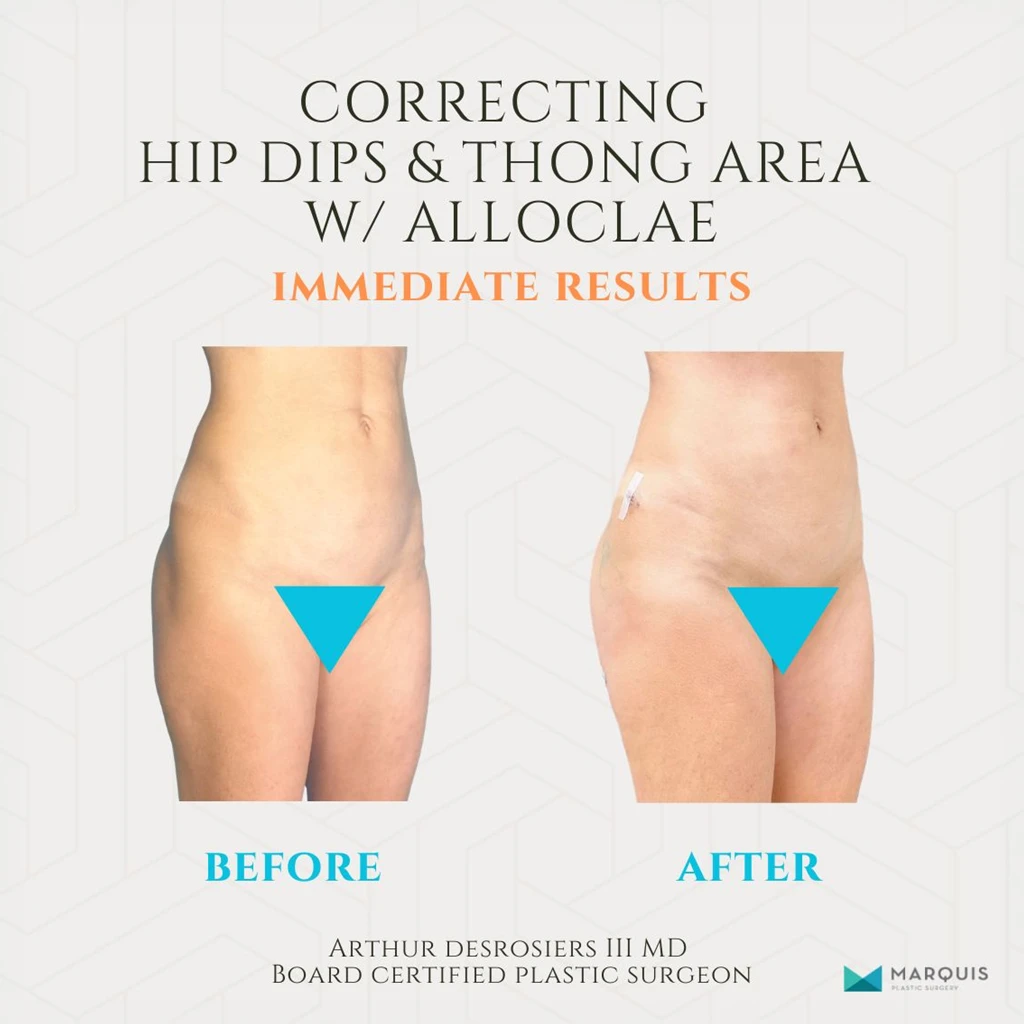
alloClae® is one of the newest tools available for natural-looking body contouring and volume restoration. It allows surgeons to enhance areas of the body (such as the breasts, hip dips, labia majora, and buttocks) without the need for liposuction to harvest a patient’s own fat. alloClae comes in sterile packaging off-the-shelf. It can also be used to correct contour irregularities from prior liposuction, or to even out areas from a prior BBL, for example.
Because alloClae is relatively new, many patients have questions about how it works, how it compares to traditional fat grafting, and whether it is safe.
In our practice, we have worked extensively with alloClae and have also helped teach other providers how to inject alloClae safely and effectively. Through this experience, we have developed several practical insights that help make the procedure smoother and more predictable for patients.
This guide explains what alloClae is, how it works, and what patients should know if they are considering treatment.

What Is alloClae?
In practical terms, this allows alloClae to function as an off-the-shelf fat grafting option.
Instead of performing liposuction to harvest fat from another area of the patient’s body, the surgeon can inject alloClae directly into the area where additional volume is desired.
Common treatment areas include:
- breast contour enhancement
- hip dips and hip contouring
- buttock shaping and skinny BBL
- correction of contour irregularities (e.g. post-liposuction)
For more on alloClae’s composition and the science/technology behind the product, visit our other alloClae blog here.
How alloClae Compares to Traditional Fat Grafting
Compared to traditional fat grafting, alloClae eliminates the need for fat harvesting, may have lower resorption rates, and may require less volume to achieve a similar aesthetic result.
Fat Harvest
Traditional fat grafting typically involves three steps: 1) liposuction to harvest fat; 2) processing the fat; and 3) reinjecting the fat into the desired area.
alloClae eliminates the harvesting step. Instead of performing liposuction to obtain fat from another area of the body, alloClae is an off-the-shelf, ready-to-inject adipose product that can often be injected in the office setting.
Resorption
With traditional fat grafting, it’s common for 40–60% of the transferred fat to be reabsorbed by the body (go away). Early results with alloClae indicate higher retention, averaging around 80% or more. However, long-term data from alloClae is still being collected.
As always, results can vary from person to person.
Less Product?
In our experience – having been one of the early practices to work with alloClae during its soft launch, and among the first in South Florida to use it – it appears to go somewhat farther than traditionally harvested fat once you account for differences in resorption.
For example, if you assume about 50% resorption for liposuctioned fat and closer to 80% retention with alloClae, you might need around 250cc of liposuctioned fat to achieve a certain result versus roughly 75–100cc of alloClae to reach a similar outcome. Based on retention alone, a more direct comparison would be closer to ~150cc of alloClae.
The fact that we are often seeing comparable results with less volume suggests there may be additional factors at play beyond retention alone.
That said, results can vary from patient to patient. While alloClae is still relatively new to the market, both the manufacturer and surgeons have accumulated meaningful early experience, and we are continuing to build on that data to better understand how consistent these observations are across a broader patient population.
So why might alloClae seem to provide more “bang per cc” in some patients? While this will need to be confirmed more broadly, early experience suggests it may be related to two main factors: 1) how the fat is harvested and processed, and 2) the characteristics of the source tissue. These remain areas of active observation and ongoing refinement but let’s talk about this theory.
Focusing on the harvest process, the key distinction is how the fat is removed. With alloClae, fat is excised in larger, intact pieces for processing. In contrast, with liposuction, fat is broken into small globules and suctioned through a narrow cannula.
A helpful analogy is the difference between a loaf of bread and breadcrumbs. When the structure is preserved, like a loaf, it remains light and airy. When it’s broken down into small pieces, like breadcrumbs, it becomes denser and more compact. Liposuctioned fat behaves more like breadcrumbs due to the mechanical disruption during harvest, whereas alloClae retains more of an intact, airy structure.
Focusing on the type of fat used, tissue quality can vary depending on the donor site. Adipose tissue from certain areas (e.g., flanks or abdomen) tends to have lower fibrous content and may be more suitable for grafting, whereas fat from areas such as the upper back or arms can be more fibrous. Increased fibrous content can impact graft viability and retention.
In traditional fat grafting, the surgeon is limited to the patient’s available donor sites, which may be more fibrous in nature. In contrast, alloClae is derived from donor tissue that can be selected and processed to achieve more consistent characteristics, which may contribute to its more uniform, “airy” consistency.
Why Technique Matters With alloClae
Although alloClae simplifies fat grafting by eliminating liposuction, proper injection technique is still important.
Surgeons who work with alloClae regularly learn small technical details that help ensure the procedure goes smoothly and that the product distributes evenly within the tissue.
In our practice, we have used alloClae extensively since its commercial launch and have also helped educate other physicians and providers on injection techniques and best practices.
Over time, we have developed several practical protocols that improve both the injection process and patient experience.
Practical Insights From Clinical Experience With alloClae
1) Antihistamines May Help Reduce Temporary Streaking
alloClae contains a small amount of lubricating oil that helps the product inject smoothly. In some patients, this can occasionally cause temporary histamine streaking, which appears as redness or itching in the treated area. This can be confused with infection.
To minimize temporary post-procedure streaking, we often recommend patients take an over-the-counter antihistamine such as Zyrtec on the day of the procedure and for 2–3 days afterward. We also generally recommend hydroxyzine, another type antihistamine, at night because it makes most people feel too drowsy for daytime use. If there is no “redness” / streaking then the antihistamine can be stopped.
Note, we do not typically prescribe antibiotics for allClae injections. Absent special circumstances, it is generally not necessary; the procedure is performed sterile with sterile prep, sterile cannula, and the surgeon uses sterile gloves and sterile gauze.
2) Proper Cannula Preparation Helps the Injection Process
Before injection, the cannula should be primed with sterile saline. This step helps ensure the product flows smoothly through the cannula. Without priming, the product may not flow easily, which can make the injection process more difficult.
3) Creating the Tissue Path First Improves Distribution
Another helpful step is gently creating crisscrossed pattern of tissue tunnels with the cannula (“pre-tunneling”) before injecting the product. This allows the alloClae to distribute more evenly within the treatment area.
4) Small Entry Points Allow Precise Placement
alloClae is injected through small access points in the skin using a cannula. While the kit includes a scalpel for creating the entry site, in my experience it is often larger than necessary.
Dr. Desrosiers typically prefer using a #15 blade to create a smaller, more precise entry point, which tends to heal very well and often leaves little to no visible mark.
These small entry sites are usually closed with Dermabond (medical glue) and Steri-Strips, allowing them to heal quickly with minimal visible evidence of the procedure.
FAQs on AlloClae
What Volume of alloClae can be Injected Per Session?
The appropriate volume depends on the area being treated, the patient’s anatomy, and the desired result.
In our experience, most patients tolerate approximately 100–200 cc per treatment session comfortably under local anesthesia. When larger volumes are desired, some patients prefer IV sedation to remain comfortable during the procedure.
How Far Do Treatments to the Same Area Need to be Spaced?
In most cases, treatments to the same area are spaced about three months apart.
When additional volume is desired, this interval allows time for the body to integrate the adipose matrix and for the initial volume to stabilize. It also gives the surgeon an opportunity to evaluate the contour and determine how much additional volume, if any, would improve the result.
Spacing treatments appropriately helps produce more precise, natural-looking outcomes.
Can alloClae Be Used in the Face?
No, alloClae is not for facial injection.
The current formulation contains a lubricating oil that is designed for body applications. For this reason, the manufacturer does not recommend using alloClae in the face. Research is ongoing to develop a formulation specifically designed for facial use, but until such a product becomes available, alloClae should not be injected in the face.
For patients interested in off the-shelf options for facial fat grafting, products such as Lipoderma may be considered. You can read more about Lipoderma here.
Is alloClae Right for You?
alloClae can be an excellent option for patients who want natural volume restoration without undergoing liposuction.
- do not have enough fat for traditional fat grafting (think: skinny BBL)
- want to avoid donor-site surgery
- want body contouring with a shorter procedure (awake in-office or quick IV sedation)
However, traditional fat grafting may still be the best choice in some cases. The best approach depends on the patient’s anatomy and aesthetic goals.
Consultation for alloClae Treatment
alloClae is a relatively new technology, and experience with the product and injection technique matters.
During your consultation, we will evaluate your anatomy, discuss your goals, and determine whether alloClae is the best approach for your situation. For more info on pricing comparison between body fillers and how alloClae is more cost-effective than Leneva or Lipoderma see our blog here.
If you are interested in alloClae body contouring or breast volume enhancement, we invite you to schedule a consultation to learn more about your options, or call 305-403-2922, or email us at concierge@ArthurMD.com.
[1] Fanniel V, Atawneh I, Savoie J, Izaguirre-Ramirez M, Marquez J, Khorsandi C, Hill S. Advancing Soft Tissue Reconstruction with a Ready-to-Use Human Adipose Allograft. Bioengineering (Basel). 2025 Jun 4;12(6):612. doi: 10.3390/bioengineering12060612. PMID: 40564428; PMCID: PMC12189649. Available at: https://pmc.ncbi.nlm.nih.gov/articles/PMC12189649/.
[2] Morel SBA, Vranis N, Perez J, Nikolis A, Ghavami A, Safran T. Current Applications and Indications of Allograft Adipose Matrix: A Systematic Review. Plast Reconstr Surg. 2025 Oct 7. doi: 10.1097/PRS.00000000000125 6. Epub ahead of print. PMID: 41056060. Available at: https://pubmed.ncbi.nlm.nih.gov/41056060/.

Contact Us To Schedule Your Consultation
Our Latest Posts