
For decades, facelifts were most commonly associated with patients in their 50s and 60s seeking to address more advanced signs of aging. Younger patients often avoided surgical options, largely because traditional facelifts required larger incisions, were more invasive, and involved meaningful downtime.
That paradigm is changing.
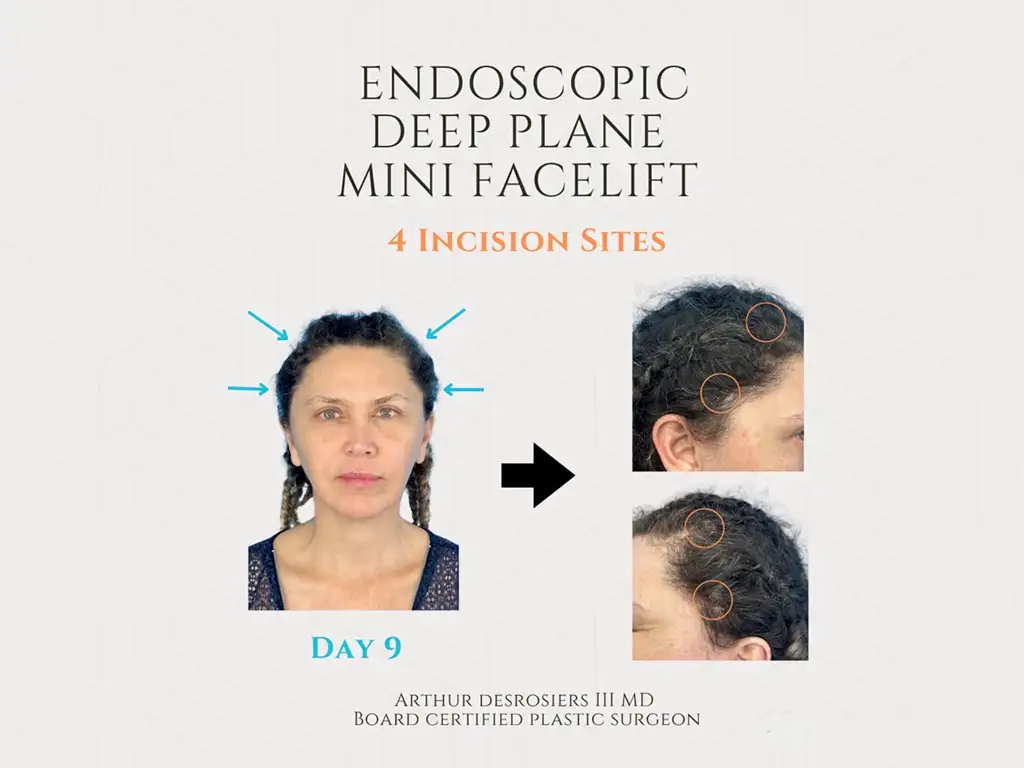
With the development of the endoscopic deep plane facelift, patients now have an option that is less invasive while still delivering the kind of structural, long-lasting rejuvenation that only surgery can achieve. Endoscopic refers to the technique of using a very small 4 mm video camera and highly specialized equipment to complete a facelift through four 10-24mm incisions placed well behind the hair line in most patients. By using smaller incisions and a more precise approach to repositioning deeper facial structures, this technique can often reduce downtime compared to traditional open facelifts.
As a result, more patients in their 40s, and even select patients in their 30s, are choosing to intervene earlier, before aging becomes more pronounced. The goal is not to look different, but to maintain balanced, youthful facial structure over time.
The “Lindsay Lohan” Effect
The endoscopic deep plane facelift was already gaining traction among patients interested in earlier, natural-looking rejuvenation. But public awareness of the procedure accelerated dramatically when Lindsay Lohan reappeared in the media looking notably refreshed and rejuvenated.
While we were not involved in her care and can only speculate, many observers believe her transformation reflects the type of result often associated with an endoscopic deep plane facelift—specifically, a restoration of youthful structure and balance without the telltale signs of traditional facelift surgery.
What made this moment so impactful was not just the visibility, but the subtlety. The result did not look “done.” It looked like a natural, well-rested version of herself.
That shift in perception matters. For many patients, this was the first widely speculated example of how modern facelift techniques may deliver meaningful rejuvenation while still leaving people wondering what, if anything, was done.
The Endoscopic Deep Plane Facelift: What That Actually Means
An endoscopic minimally invasive deep plane facelift lifts the deeper structural layers of the face from the top down. That’s a lot of terminology, so let’s break it down.
Endoscopic refers to the use of a very small fiber optic camera that allows the surgeon to see beneath the surface with magnified, high-definition visualization.
Minimally invasive means the procedure is performed through small, well-hidden incisions with less disruption of surrounding tissue. This can translate to reduced swelling, smaller scars, and a smoother recovery process for many patients.
Deep plane refers to the anatomical layer that forms the structural foundation of the face. This is the strong fascial layer that supports the overlying soft tissue and skin, and whereby the surgical technique produces a meaningful, long-lasting rejuvenation occurs.
Top-down approach refers to the placement of the incisions within the hairline. This allows the surgeon to approach the facial structures from above, creating a more favorable angle to reposition tissues toward their pre-aging position.
How This Differs from a Traditional Facelift
Traditional facelifts use an “open” approach, with incisions placed along the natural contours in front of the ear and extending into the hairline.
With this technique, the skin is elevated from the side to allow the surgeon to directly view and reposition the underlying tissues, whether working at the SMAS level or in the deep plane. This provides broad exposure, but the lifting is often performed with a more lateral, or backward, vector. Although there are multiple modifications of the SMAS technique that do create dual vectors, they require major incisions on the face. Limited “short scar” facelifts don’t provide adequate visualization and a result provide “shorter” results that don’t last as long as the deep plane. And although there are several techniques for deep plane facelift, only the endoscopic approach is a minimally invasive with minimal scars.
In contrast, an endoscopic deep plane facelift uses a series of small, hidden incisions within the hairline. A high-definition camera provides a magnified view of the deeper facial structures, allowing the surgeon to work with a high degree of precision through these smaller access points.
This enhanced visualization is not just about precision – it also has important safety implications. The magnified, illuminated view allows for clearer identification of key anatomical structures, including nerves and blood vessels. This can be especially important for persons that have atypical positioning of e.g., the facial nerve.
Because the surgeon is working from a top-down perspective, this approach also allows for targeted release of key retaining ligaments and repositioning of the deeper tissues in a more vertical, upward direction, rather than pulling the face backward.
As a result, the goal is not to pull the face back, but to restore it—repositioning the underlying structures in a way that looks balanced and refreshed.
Do You Still Remove Skin with an Endoscopic Facelift?
It depends on the patient.
In younger patients, skin removal is often not necessary. By lifting the face up and surgically securing the deep plane in the brow and midface to the deep temporal fascia, the need for skin removal is often mitigated.
In patients in their 50s, skin removal may be needed in select areas; alternatively, fat grafting in specific areas might reduce the need for skin removal. In patients that are too skinny for autologous fat harvest/grafting, there is exciting new technology called Lipoderma [CN1.1]that is safe, off-the-shelf injections in specific areas.
In patients in their 60s and beyond, some degree of skin removal is more commonly part of the procedure. In this modification of the endoscopic deep plane, the upper face / brow and midface / jaw are still done with the minimally invasive approach, and there are no scars on the face, nor in front of the ear. The only scars are generally hidden behind the ears.
The key difference with the endoscopic approach is that the deeper structural layers are repositioned first. As these underlying structures are restored, the skin often redrapes naturally, which typically reduces the need for skin removal compared to a traditional facelift.
When additional refinement is needed, it can be addressed through small, well-concealed incisions tailored to each patient’s anatomy and goals.
Why Younger Patients Are Choosing Endoscopic Deep Plane Facelifts
Many patients today are seeking natural-looking facial rejuvenation rather than dramatic transformation.
1. Early Structural Aging Can Be Addressed
Facial aging often begins earlier than many people realize.
Common early changes include:
- slight descent of the midface and cheeks
- early development of nasolabial folds
- subtle brow heaviness or upper eyelid hooding
- early jawline softening or jowling
- mild neck laxity or platysma banding
These changes often begin in the late 30s or early 40s. Traditionally, they have been managed with Botox and filler. While these treatments can be very effective, they have limitations and may not fully address deeper structural changes over time.
With advances in endoscopic deep plane facelift techniques, performing surgery earlier in select patients has become more common. Because excess skin is typically minimal at this stage, repositioning deeper tissues alone can often restore youthful contours.
2. More Natural Facial Rejuvenation
One reason the deep plane facelift has become increasingly popular is that it produces more natural results.
Instead of tightening skin, the surgeon lifts the entire facial soft tissue unit, including:
- the SMAS layer (the structural foundation of the face)
- the cheek fat pads
- the midface support structures
Because the dissection is performed beneath the SMAS, these structures are lifted together as a composite unit. In simple terms, when the foundation is repositioned, everything above it moves with it.
By lifting the deeper structures vertically and obliquely, the face is restored to a more youthful position without creating an overly tight or pulled appearance.
3. Smaller, More Discreet Incisions
The endoscopic approach allows many aspects of the procedure to be performed through small incisions hidden within the hairline and temporal region.
Compared to traditional facelifts, this often means:
- smaller incisions
- less visible scarring
- less disruption to the skin
In some cases, a small, well-concealed incision behind the ear may be used for additional refinement. However, the prominent incision in front of the ear used in traditional facelifts is often avoided.
For patients concerned about visible scars, this can be a meaningful advantage.
4. Smoother Recovery for Many Patients
Patients in their 30s and 40s often have demanding professional and personal lives, making lengthy recovery periods difficult.
Because the endoscopic deep plane facelift uses smaller incisions and precise, targeted dissection, many patients experience less swelling and a quicker return to social activities compared with more extensive facelift approaches.
Recovery varies for each individual, but many patients feel comfortable returning to normal activities sooner than expected.
Specialized Training in Endoscopic Deep Plane Facelift Techniques
Facial rejuvenation surgery requires a deep understanding of anatomy and advanced surgical technique.
Dr. Arthur completed fellowship training in craniofacial cosmetic surgery and trained with Chia Chi Kao, a pioneer of the endoscopic deep plane facelift technique.
Dr. Kao developed a variation of the procedure commonly referred to as the Ponytail Lift®, which focuses on lifting deeper facial tissues through small hairline incisions.
This specialized training allows for a thoughtful evaluation of whether an endoscopic deep plane facelift, traditional deep plane facelift, or a combined approach is best suited to each patient’s anatomy and aesthetic goals.
Who Is a Good Candidate for an Endoscopic Deep Plane Facelift?
Patients who may benefit most from an endoscopic deep plane facelift often share characteristics such as:
- early facial aging (commonly ages 30–50)
- mild to moderate midface descent
- early jawline softening
- minimal excess skin
- a preference for natural-looking rejuvenation
Every face ages differently, and the most appropriate procedure depends on individual anatomy and goals.
Schedule a Consultation
If you are considering a deep plane facelift or an endoscopic deep plane facelift, a consultation is the best way to understand your options.
Facial rejuvenation surgery is highly individualized, and careful evaluation of facial anatomy is essential to achieving balanced, natural-looking results.
During your consultation, we will take the time to understand your goals, evaluate your facial structure, and discuss the most appropriate approach for you.
If you would like to learn more about endoscopic deep plane facelifts in Miami, we invite you to contact our office to schedule a consultation: 305-403-2922 or concierge@ArthurMD.com.
FAQs
Is 30 too young for an endoscopic facelift?
No. Many patients in their 30s and 40s are appropriate candidates, depending on their anatomy and goals.
How long does the surgery take?
Typically, an endoscopic deep plane facelift takes approximately 5–7 hours.
Do I need general anesthesia?
Many patients can undergo this procedure under IV sedation rather than general anesthesia.
Who administers the sedation?
In our practice, an anesthesiologist administers IV sedation.
How long is recovery?
Recovery varies, but many patients feel comfortable returning to social activities within about a week, which is often sooner than with more traditional approaches.
Can this be combined with other procedures?
Yes. Procedures such as canthopexy may be performed at the same time using specialized techniques.
How long do results last?
Results are long-lasting but vary by patient. Some patients may maintain results for many years depending on factors such as aging, skin quality, and lifestyle.

Contact Us To Schedule Your Consultation
Our Latest Posts