
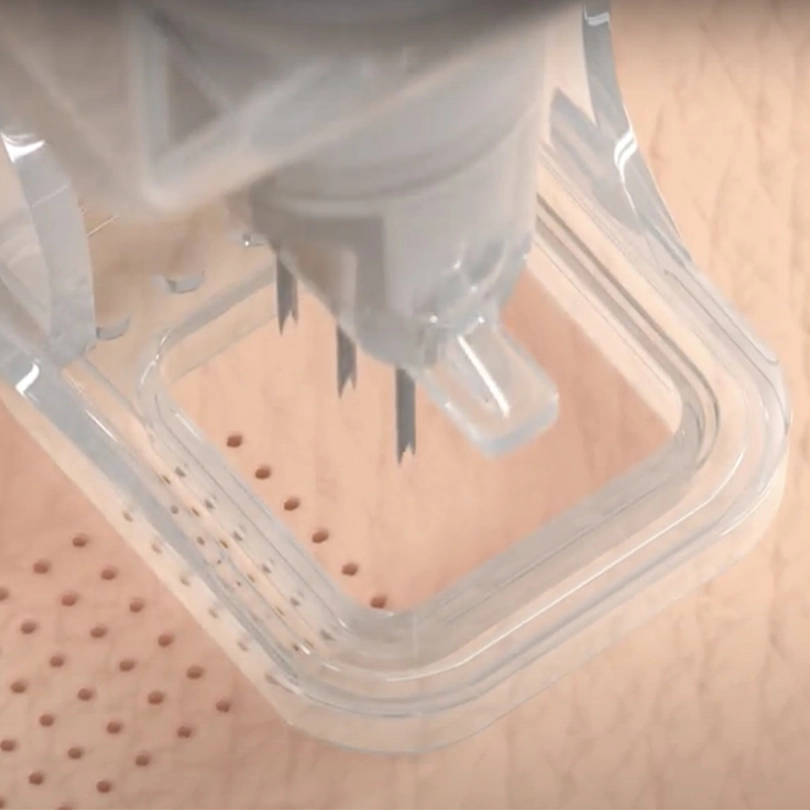
The Ellacor® System with Micro-Coring® Technology is the first and only non-surgical, non-thermal device that works by removing skin on the microscale. One treatment shrinks the skin on the face by ~8.5% and three treatments by nearly 25%. Ellacor provides a natural-looking results with minimal downtime. In clinical trials, more than 86% of patients were satisfied with their their results.


Contact Us To Schedule Your Consultation
We like this technology over RF-based devices because there’s no thermal component. Devices with a thermal component can cause fat loss and/or excessive scar tissue. Fat loss in the face can make people look older. This is the opposite of what we aim to achieve.
Certain medical conditions, a history of poor wound healing, or a past history of keloids may be a relative or absolute contraindication. This is why it’s important to have a full consultation with a Board Certified Plastic Surgeon to assess whether you’re a candidate.
Ideal candidates are generally adults who have visible signs of facial aging and are seeking an improvement in skin laxity. The device is approved for Fitzpatrick skin types I-IV.
On the day of your procedure, patients receive a local anesthetic. Once your skin is numb, Dr. Desrosiers will strategically place the Ellacor device on your skin to create tiny micro-cores in a precise grid-like pattern. Once complete, patients go home the same day. Soreness and redness are common. Patients cannot wear makeup or other cosmetic products on the face for 4-5 days following the procedure and must stay out of the sun until fully healed.
The clinical trials evaluated the device’s efficacy on the face. However, physicians have used Ellacor on other areas such as the abdomen, underarms, and neck. Patients interested in treating other areas should discuss their goals with Dr. Desrosiers.
Although both procedures involve needles to rejuvenate the skin, Ellacor uses tiny hollow needles to remove microscopic skin cores. In contrast, microneedling punctures the skin superficially without removing any skin cores. You might think of Ellacor as “microneedling on steroids.”
It mostly depends on your skin goals. Ellacor is designed to tighten the skin, increase collagen, and help improve skin texture. Microneedling is designed to increase collagen and improve skin texture.
Most patients can work the day after Ellacor. However, it’s often easy for others to see that a person had the procedure during the first 5-7 days. This may bother some people and they may wish to take more time off work or work from home. Note, redness can last for more than 1 week in some patients. Talk to your doctor about certain topical medications that can help speed up redness resolution.
The recovery period for microneedling is typically 3-5 days. The initial recovery period for Ellacor is 5-7 days for most people. During this period most doctors advise people not to wear makeup or creams on the treated area except for petrolatum jelly.
It depends. We often find that younger patients’ concerns resolve in 1-2 sessions while older patients in 2-3 sessions.
For some patients, touch-ups are recommended every 2-3 years.
No. Ellacor does not use radiofrequency and instead removes small micro-cores of skin. Morpheus is a radiofrequency-based device that delivers thermal energy to the skin. This thermal energy can damage fat and sometimes cause excessive scar tissue.
The density of cores is also adjustable from 3% up to 8%. The density of cores translates into how many cores are taken per square centimeter of skin. The higher the percentage, the more skin removed and the greater the skin tightening. The doctor adjusts the density of cores during treatment based on the patient’s anatomy and goals.
The depth of the micro-coring is adjustable from 0.5 mm to 4.0 mm. Because the Ellacor is designed to go through all layers of the skin, the doctor changes the depth during the treatment depending on the patient’s anatomy.
Clinical data demonstrates that this innovative dermal micro-coring device is an effective treatment of moderate-to-severe facial wrinkles. Over 86% of clinical trial patients were satisfied with their results.
The length of time depends on the area. Including the application of topical anesthesia and waiting time for that to take effect, office visits for the procedure on the face typically take about 2-2.5 hours.
Generally, yes. Most people receive an oral sedative before the procedure to increase patient comfort. After an oral sedative, patients must have a friend or loved one drive them home.
Generally, patients will need to discontinue all blood thinners for two weeks before the procedure. Common over the counter blood thinners include: Ibuprofen, Advil, Motrin, Aspirin, Excedrin, Naproxen, alcohol, fish oil, and some herbal supplements. If you have been prescribed any anticoagulant (blood thinner) or anti-platelet, it’s critical to consult your physician before stopping.
The exact medication varies based on the unique needs of each patient. However, oral benzodiazepines are commonly used.
Lastly, after the facial area is substantially numb, a field block is performed with long-acting 0.25% bupivacaine with epinephrine. This step is an extra precaution to ensure all areas are sufficiently numb.
After the dental block takes effect, a lateral check block is performed. This is typically fanned in with a blunt-tip cannula to decrease pain and uses long-acting 0.25% bupivacaine with epinephrine (for hemostasis).
The dental block is similar to what you may have received during common dental work. This block typically uses 1% lidocaine with bicarbonate (to decrease burning). This block is given first and it makes the midface numb (from under the eyes to the chin).
Patients typically receive three types of local anesthetic block: 1) intraoral dental block; 2) lateral cheek block; and 3) lower face field block.
In our experience, about 30-40% of patients report a mild burning sensation with the first few bupivacaine injections. This burning is attributable to a pH difference between the tissue and the medicine.
Most patients tolerate micro-coring well and do not have significant discomfort after the anesthetic is injected. The local anesthetic injection is typically the “worst” part.
No. The treatment does not cause herpes. However, the treatment can reactive a prior infection. Studies demonstrate that approximately 8% of patients will develop a herpes outbreak after any type of facial intervention performed around the lips – e.g., chemical peel, laser, or filler, etc. For this reason, prophylaxis medicine is commonly given to patients to prevent an outbreak.
Most patients report that the redness resolves in 5-7 days, although some patients report redness lasting several weeks to months. To help prevent redness and expedite the lessening of any redness, most patients are given oral TXA and topical cysteamine.
Each treatment typically costs $3,000 – $6,000. The exact price depends on size and the number of handpieces used (the larger the surface area, the more handpieces are used).
The Ellacor system is FDA-cleared for the treatment of moderate to severe wrinkles in the mid to lower face.
We see cosmetic patients in our Miami and West Palm Beach offices. You can call 305-403-2922 or email concierge@ArthurMD.com to book your appointment. Only one-hour concierge appointments are available at the West Palm office.