
What Is an Endoscopic Deep Plane Facelift?
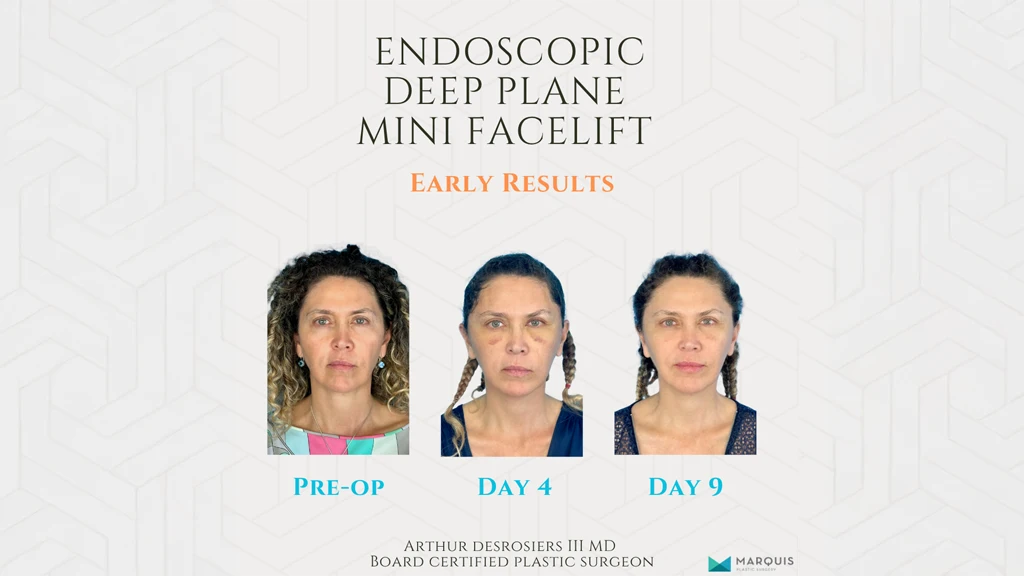
What Areas of the Face are Treated with an Endoscopic Facelift?
An endoscopic facelift often includes a combination of endoscopic procedures performed during the same surgery for full facial rejuvenation. For example, an endoscopic facelift can include: an endoscopic brow lift, endoscopic forehead lift, endoscopic deep plane midface lift, endoscopic jaw lift, and/or endoscopic neck lift.

In younger patients, surgeons most often combine an endoscopic brow lift with an endoscopic midface lift (in the deep plane). This technique targets the brows, cheeks, and smile lines.
For older patients, the endoscopic approach is commonly expanded to also include a jaw lift and neck lift for more comprehensive rejuvenation with small incisions made behind the ears and under the chin. Using the expanded approach, a significant vertical lift of 2 to 2.5 cm can be achieved while still maintaining a minimally invasive approach.
For both younger and older patients, the incisions are hidden behind the hairline (and possibly under the chin), making the resulting scars virtually unnoticeable for most people.
How is an Endoscopic Facelift Performed?
- Small incisions are made, hidden behind the hair line.
- Through these incisions, the surgeon inserts a tiny endoscopic camera – about 4 mm in diameter. The camera projects a 4K high-definition magnified view of the underlying anatomy onto a monitor in the operating room, allowing the surgeon and surgical team to see and work with precision.
- Instead of simply pulling the skin tighter, the surgeon repositions the deeper facial tissues to restore a more natural, youthful contour. This technique helps avoid the “overly pulled” look sometimes associated with older facelift methods.
- The endoscopic mini facelift can often be performed under local anesthesia with sedation, though in some cases general anesthesia may be recommended.
Is an Endoscopic Mini Facelift Different Than an Endoscopic Deep Plane Facelift?
An endoscopic mini facelift is simply a less invasive version of the endoscopic full facelift. Both types of facelifts are done with a midface lifting of the deep plane tissues. The term deep plane mini endoscopic facelift implies that no skin is removed (or only a very small amount) and is primarily for younger patients. Surgeons sometimes use the word “mini” when referring to this type of endoscopic facelift for younger patients because the surgery tends to be less extensive – their tissues usually need only a subtle lift. The “mini” is also appropriate when considering the minimal downtime – there is less downtime and less swelling compared to the traditional facelift.
The full endoscopic deep plane facelift still involves the endoscopic midface deep plane lifting, but also often requires a small amount of skin to be excised either behind the ear or in front of the ear. Because the endoscope is used for a careful meticulous dissection – including the upper, midface, and jawline – the patient can still enjoy the advantages of minimal downtime and faster recovery when compared to a traditional open deep plane facelift.
Is an Endoscopic Deep Plane Facelift Different Than a Ponytail Lift?
The Ponytail Lift® is a form of endoscopic facelift developed by Dr. Chia Chi Kao.
What Areas Can an Endoscopic Facelift Address?
Endoscopic facelifts are especially effective in the mid-face and brow region (but can also address the lower jawline and neck):
- Sagging cheeks – Lifts and repositions mid-face fat pads to restore youthful contours.
- Drooping brows – Elevates the brow area to correct a heavy or tired look.
- Deep nasolabial folds – Softens deep lines running from the nose to the mouth.
- Early jowling – Improves jawline definition by repositioning sagging tissues.
- Early neck laxity – reduces neck wrinkles and sharpens the angle of the jaw.
- Moderate neck laxity – this commonly needs to be done through an open incision under the chin and/or behind the ear; this maneuver sharpens the cervicomental angle (junction between chin and neck) and reduces neck wrinkles, and is necessary in older patients with moderate to severe excess skin in the neck.
What Other Procedure are Commonly Combined with an Endoscopic Facelift?
- Fox eyes (a/k/a Cat eyes) – the shape of the eye can be changed through an endoscopic approach with minimally invasive hairline incisions.
- Tear-trough implants – can be placed through an endoscopic approach.
- Eyelids – the facelift can be combined with procedures such as upper and/or lower blepharoplasty.
- Facial Fat Grafting – restores fat in locations where there is fat atrophy due to natural aging; autologous fat transfer is a safe procedure and introduces fat stem cells into the face and assist in rejuvenation of the overlying skin/tissues.
How is an Endoscopic Facelift Different Than a Traditional Facelift?
An endoscopic facelift is a less invasive alternative to a traditional facelift. Instead of long incisions around the ears as in the traditional deep plane facelift, the endoscopic deep plane facelift typically uses 4 small incisions hidden in hairline. Through these incisions, a tiny camera (endoscope) helps guide the surgeon to lift and reposition the deeper facial tissues into a more youthful position – all with minimal disruption to the skin.
A traditional facelift is more extensive. In addition to repositioning the deeper structures (deep plane facelift), it usually requires longer incisions and removal of excess skin. Because of this, a traditional facelift is often recommended for patients with significant skin laxity, while an endoscopic facelift is better suited for younger patients or those who have minimal extra skin.
In term of recovery, an endoscopic facelift typically has less downtime relative to a traditional deep plane face lift.
Feature
Endoscopic Facelift
Traditional Facelift
Invasiveness
Minimally invasive
More invasive
Incisions
Small, hidden behind hairline
Longer; around ears (front/back)
Target areas
Mid-face, brow (+/- jaw/neck)
Mid-face, jawline, neck
Recovery time
Shorter (1–2 weeks)
Longer (2–6 weeks or more)
Ideal candidates
Younger patients with mild to moderate sagging
Older patients with advanced facial aging
Scarring
Minimal
More noticeable (but often well-hidden)
Results
Subtle, natural
More dramatic
Is an Endoscopic Mini Facelift Right for You?
You may be a good candidate for an endoscopic facelift if you:
- Are noticing early signs of aging (typically between ages 30–50).
- Have mild to moderate drooping in the mid-face or brow.
- Have early laxity along the jawline or neck.
- Want a less invasive procedure with quicker recovery and minimal scarring.
- Prefer subtle, natural-looking improvements rather than dramatic changes..
For patients with significant laxity in the lower face and neck, an endoscopic facelift can still provide meaningful improvement, though the degree of correction is generally less than a traditional deep plane facelift – unless longer incisions from a traditional facelift are used to remove additional excess skin. Thus, in some cases, combining endoscopic minimally invasive for the brow and mid-face, and then combining the open approach for the neck can achieve optimal results with comparatively reduced downtime compared to a traditional deep plane facelift.
Consult a Plastic Surgeon - Craniofacial Specialist
An endoscopic facelift is a technically demanding procedure that requires precise knowledge of facial anatomy and surgical skill.
A consultation with a board-certified plastic surgeon and craniofacial specialist, such as Dr. Arthur, is essential to ensure the procedure is tailored to your unique facial structure and aesthetic goals. Dr. Arthur’s fellowship training in craniofacial cosmetic surgery uniquely equips him to expertly evaluate whether an endoscopic facelift alone – or in combination with other procedures – can achieve a safest, natural-looking outcome.
[1] Mani M. Endoscopic, “Scarless” Composite Flap Face and Neck Lift. Facial Plast Surg. 2025 Feb;41(1):43-53. doi: 10.1055/a-2204-8798. Epub 2023 Nov 6. PMID: 37931912; PMCID: PMC11745772, available at: https://pmc.ncbi.nlm.nih.gov/articles/PMC11745772/.
[2] Kao CC, Duscher D. The Ponytail Lift: 22 Years of Experience in 600 Cases of Endoscopic Deep Plane Facial Rejuvenation. Aesthet Surg J. 2024 Jun 14;44(7):671-692. doi: 10.1093/asj/sjad382. PMID: 38152870; PMCID: PMC11210079, available at: https://pmc.ncbi.nlm.nih.gov/articles/PMC11210079/.

Contact Us To Schedule Your Consultation
Our Latest Posts