
3D-Printed Custom Wraparound Jaw and Chin Implants – A More Precise Fit
Considering a stronger, more balanced jawline? Learn how custom jaw and chin implants can enhance your facial harmony with precision and personalization.
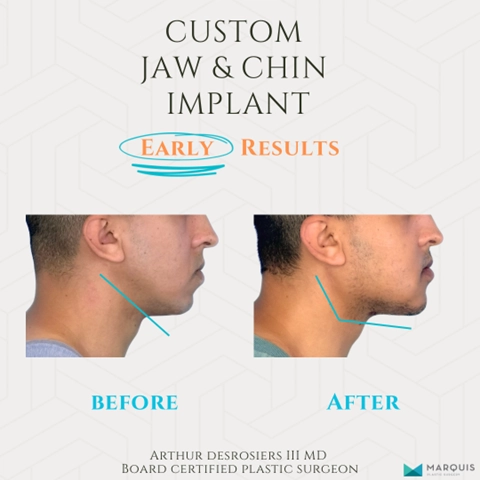
What is a custom wraparound jawline implant?
A custom chin implant with “wings” – also called wraparound jawline implant – is uniquely designed for a patient’s individual bone structure and facial harmony goals. This custom implant is unlike off-the-shelf implants, which come in generic shapes and sizes – think Small / Medium / Large. There are no ‘in-between’ sizes nor is there an ability to compensate for the fact that naturally, a patient’s left and right side are generally asymmetric. Custom implants help address this challenge.

How is my custom jaw and chin implant designed?
Once the draft is complete, Dr Arthur shows the patient the proposed design for review and approval. Any necessary revisions are made based on patient feedback, and only after final patient approval is the implant manufactured. This process typically takes 4 – 6 weeks.
To prepare for surgery, two identical, sterilized implants are produced: one for implantation during surgery and one as a backup. In addition, a third, non-sterile version of the implant and a 3D-printed model of the patient’s jaw is created so the patient and Dr. Arthur can review the design together in person. Seeing and holding a physical model helps patients more easily visualize the surgical plan.


What is the difference between a standard chin or jaw implant and a custom wrap around jawline implant?
What Materials Are Custom Wraparound Jaw and Chin Implants Made From?
Custom facial implants are typically made from medical-grade solid silicone or porous polyethylene (e.g., Medpor). Both materials are FDA-cleared, biocompatible, and long-lasting, with decades of safe use in facial reconstructive and aesthetic surgery.
What Happens During Custom Jawline Surgery? How exactly does the Surgeon Place the Wraparound Jaw Implant?
The procedure is performed under general anesthesia, typically as an outpatient surgery. For chin implants, a small incision is made either inside the mouth or under the chin.
For wraparound jaw implants, which extend along the jawline to enhance the angle and width of the jaw, the approach is slightly more involved. These implants are usually comprised of 2 or 3 connecting pieces. As a result, in addition to the small incision under the chin, the surgeon typically makes an incision inside the mouth back near the molars on each side. The surgeon then performs a subperiosteal dissection, connecting all three incisions to create a snug pocket in which the implants will be situated.
Placement of the implant requires skill and experience. Dr. Arthur utilizes a “no-touch” technique so that the implant doesn’t become contaminated by touching the outside skin on the chin or the mucosa inside the mouth. If it is a 2-piece custom implant, it fits snugly around the gonial angle on each side of the jaw and then is secured with tiny titanium screws. If it is a 3-piece implant, after the ‘wings’ are placed on each gonial angle, then the third portion (chin implant) is placed over the flanges and then secured with tiny titanium screws.
Following rigid fixation of the implants, all incisions are closed with sutures. Many times, the sutures are dissolvable.
What Is Recovery Like for a Custom Jawline Surgery?
Swelling, bruising, and a feeling of jaw tightness are common in the first weeks after surgery. While these symptoms are most noticeable early on, about 80% of the swelling gradually improves over the first 6 weeks, with subtle refinement continuing over several months.
Many patients initially experience transient mild to moderate discomfort and/or swelling, which can be managed with a combination of prescription and over-the-counter pain medications. As the swelling goes down, the patient becomes accustomed to the new jawline implants. The surgeon may also recommend wearing a neck compression garment to help minimize swelling and support healing during the first few days. Less commonly, patients have bruising or temporary nerve tingling that typically goes away with time.
Patients generally need to follow a soft food diet for anywhere from 5 days to 3 weeks, depending on the type of implant and the healing process. To reduce the risk of the sutures breaking too early, the patient may be advised to avoid brushing the mandibular teeth for a few days and instead use a water flosser (e.g. Waterpik) and antiseptic mouth rinse. The surgeon will give the patient personalized instructions on when it is possible to return to brushing and eating normally.
Interested in a Custom Wrap Around Chin and Jaw Implant?
The jawline silhouette plays a central role in facial harmony and in overall appearance and aesthetics. Whether the patient’s goal is to restore facial balance, enhance masculinity (or femininity), or correct underlying asymmetry – a custom jawline implant may be the solution. Book a consultation today and see what’s possible!
[1] Später T, Menger MD, Laschke MW. Vascularization Strategies for Porous Polyethylene Implants. Tissue Eng Part B Rev. 2021 Feb;27(1):29-38. doi: 10.1089/ten.TEB.2020.0077. Epub 2020 Aug 3. PMID: 32524897.
[2] Rojas YA, Sinnott C, Colasante C, Samas J, Reish RG. Facial Implants: Controversies and Criticism. A Comprehensive Review of the Current Literature. Plast Reconstr Surg. 2018 Oct;142(4):991-999. doi: 10.1097/PRS.0000000000004765. PMID: 29994843; available https://pubmed.ncbi.nlm.nih.gov/29994843 and Liao CD, Rodriguez E, Zhao K, Kunda N, George F. Complications Following Alloplastic Chin Augmentation: A Systematic Review of Implant Materials and Surgical Techniques. Ann Plast Surg. 2023 Jun 1;90(6S Suppl 5):S515-S520. doi: 10.1097/SAP.0000000000003423. Epub 2023 Feb 18. PMID: 36880789; available at: https://pubmed.ncbi.nlm.nih.gov/36880789/.
[3] Mommaerts MY. The ideal male jaw angle–An Internet survey. J Craniomaxillofac Surg. 2016 Apr;44(4):381-91. doi: 10.1016/j.jcms.2015.12.012. Epub 2016 Jan 21. PMID: 26888465; available at: https://pubmed.ncbi.nlm.nih.gov/26888465/.
[4] Cronin BJ, Lee JC. Preoperative Radiology and Virtual Surgical Planning. Oral Maxillofac Surg Clin North Am. 2024 May;36(2):171-182. doi: 10.1016/j.coms.2023.12.006. Epub 2024 Feb 2. PMID: 38310029; available at: https://pubmed.ncbi.nlm.nih.gov/38310029/.
[5] Cronin BJ, Lee JC. Preoperative Radiology and Virtual Surgical Planning. Oral Maxillofac Surg Clin North Am. 2024 May;36(2):171-182. doi: 10.1016/j.coms.2023.12.006. Epub 2024 Feb 2. PMID: 38310029; available at: https://pubmed.ncbi.nlm.nih.gov/38310029/.
[6] Slavin BV, Ehlen QT, Costello JP 2nd, Nayak VV, Bonfante EA, Benalcázar Jalkh EB, Runyan CM, Witek L, Coelho PG. 3D Printing Applications for Craniomaxillofacial Reconstruction: A Sweeping Review. ACS Biomater Sci Eng. 2023 Dec 11;9(12):6586-6609. doi: 10.1021/acsbiomaterials.3c01171. Epub 2023 Nov 20. PMID: 37982644; PMCID: PMC11229092; available at: https://pubmed.ncbi.nlm.nih.gov/37982644/.

Contact Us To Schedule Your Consultation
Our Latest Posts