
While free liquid silicone injections may appear to offer a quick and affordable alternative to traditional breast implants, they come with serious risks and the potential for severe complications. If you have received or are considering these injections, it’s crucial to understand both the dangers and the treatment options that may be available. Below, we explain the risks associated with free liquid silicone breast injections, clarify how dangerous injected liquid silicone differs from the much safes cohesive silicone used in breast implants, and outline potential treatment options for those individuals affected.
Complications of Breast Silicone Injections
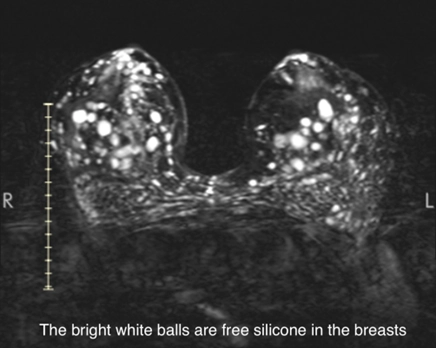
One study showed that individuals developed complications from silicone oil injections into the breast on average nine years after treatment.1 However, problems were reported as early as one year and as late as 20 years after injection. The most common complaint was breast pain (mastodynia). A more serious concern, however, was the formation of lumps called granulomas. These lumps can develop not only within the breast, but also along the chest wall and near the collarbone (supraclavicular area). Granulomas can feel very similar to breast cancer, as both form hard, irregular masses. In addition, free silicone within the breast makes it difficult for doctors to properly examine the tissue. Mammograms often cannot produce clear images because the silicone blocks the view, and ultrasound imaging is also limited due to a “snowstorm” effect, where silicone causes a shadow that obscures the surrounding tissue.
Liquid silicone injections are associated with a range of complications, including:
- Silicone Migration: Silicone can spread to other parts of the body, potentially affecting vital organs or causing nerve pain.
- Skin Color Changes: Immune reactions to silicone can cause changes in skin color and sensitivity.
- Pain: Nerve irritation from silicone can cause ongoing discomfort and pain.
- Tissue Necrosis: Severe inflammation can lead to skin breakdown and tissue death.
- Infection: Silicone can introduce bacteria into the tissue, leading to infections.
- Fibrosis: Scar tissue may form around the silicone, causing deformity and discomfort.
- Silicone Embolism: Silicone can enter the bloodstream and travel to vital organs such as the lungs or brain, which can cause permanent injury or even death.2
These complications often require surgical intervention and, in many cases, multiple procedures depending on the severity.

Are Other Harmful Substances Injected into the Breasts Besides Liquid Silicone Oil?
When Should Silicone Oil Be Removed from the Breasts?
Most surgeons recommend removing silicone oil as soon as possible. The longer it remains in the body, the greater the chance it will migrate into surrounding tissues, increasing the risk of serious complications and making removal and reconstruction more complex. Early removal often offers the best chance to minimize these risks.
Can 100% of the Silicone Oil be Removed?
Generally, no. Although it is usually not possible to remove all the silicone once it has started to migrate, prompt treatment often allows for a more complete and safer removal.
Is Free Liquid Silicone Different from Silicone Breast Implants?
Yes.
When you hear the word “silicone,” it’s important to know that it refers to a wide range of materials, all of which contain the element silicon. However, the specific properties of these materials can differ significantly.
Let’s break down the difference between the silicone used in breast implants and the silicone used in body injections. The silicone used in breast implants is highly crosslinked, meaning its molecules are tightly bonded together. This gives it a firm and cohesive texture, so much so that it couldn’t even be pushed through a regular hypodermic needle.
On the other hand, free liquid silicone injections use a much thinner, runnier form of silicone oil. Unlike the cohesive gel in implants, this liquid silicone oil doesn’t have the same strong, connected structure. As a result, it’s much more fluid and mobile, meaning it can easily spread through tissues after being injected. In some cases, it can even travel far from the original injection site, making it difficult to control (and as a result, more dangerous).
Thus, even though the exact structure of non-FDA-approved silicone oil used in body fillers may be unknown—since these products are often illegal and unregulated—we can still observe a clear difference in cohesiveness, which tells us that the silicone used is chemically distinct from that found in FDA-approved breast implants.
Are there any FDA-cleared fillers that are safer for injection into the Breasts?
Yes. Fat matrix fillers are safer to inject into the breast. Leneva is a cadaveric allograft adipose matrix injection that is FDA-cleared and safe for injection. Surgeons have successfully and safely injection Leneva into the breasts for years, for example, for breast reconstruction after surgery for breast cancer.
Alloclae is a newer, exciting option for larger volume fat matrix injections into the breast. Alloclae is an off-the-shelf allograft adipose matrix injectable that serves as an alternative to autologous fat grafting and liposuction.Since Alloclae comes in larger size syringes (12.5mL and 25.0mL) compared to Leneva. For more information on Alloclae, check out our Blog post about Alloclae here.
Note that any type of fat grafting to the breast can create imaging artifacts, which may complicate the interpretation of mammograms.
What Options Are Available for Fixing Breasts After Silicone Oil Injections?
If you’ve had silicone oil injections, it’s important to consult a qualified plastic surgeon who can assess your individual situation. They will develop a personalized treatment plan based on your condition. Typically, procedures may involve a lumpectomy or a nipple-sparing mastectomy, followed by reconstructive options such as fat grafting or breast implants, depending on the severity of the issue. Fat grafting can involve classic autologous lipoharvest with liposuction technique, or, newer technology is allograft fat matrix injections such as Alloclae. These adipose filler injections can be performed in the office as a lunchtime procedure without the need for general anesthesia and minimal downtime. Surgical options such as breast implant reconstruction may be single stage with or without acellular dermal matrix (ADM) or may require two-staged reconstruction with a tissue expander, similar to the techniques used for breast cancer reconstruction. These procedures can be combined with mastopexy if the nipple needs to be lifted and repositioned. It is important to find a board-certified plastic surgeon because reconstruction can be complex.
[1] Hilton JD, Steinke K. Extensive migration of injected free liquid silicone for breast augmentation with related major complications. BJR Case Rep. 2015 May 15;1(2):20150098.
[2] Lee SK, Kim SM, Cho SH, Lee JD, Kim HS. Adverse reactions to injectable soft tissue fillers: memorable cases and their clinico-pathological overview. J Cosmet Laser Ther. 2015 Apr;17(2):102-8. doi: 10.3109/14764172.2014.968584. Epub 2014 Oct 16. PMID: 25260141.
[3] Hilton JD, Steinke K. Extensive migration of injected free liquid silicone for breast augmentation with related major complications. BJR Case Rep. 2015 May 15;1(2):20150098.
[4] Lee SK, Kim SM, Cho SH, Lee JD, Kim HS. Adverse reactions to injectable soft tissue fillers: memorable cases and their clinico-pathological overview. J Cosmet Laser Ther. 2015 Apr;17(2):102-8. doi: 10.3109/14764172.2014.968584. Epub 2014 Oct 16. PMID: 25260141.
Referenced Articles:

Contact Us To Schedule Your Consultation
Our Latest Posts